
Different Breast Shapes

18 Sep
Different Breast Shapes
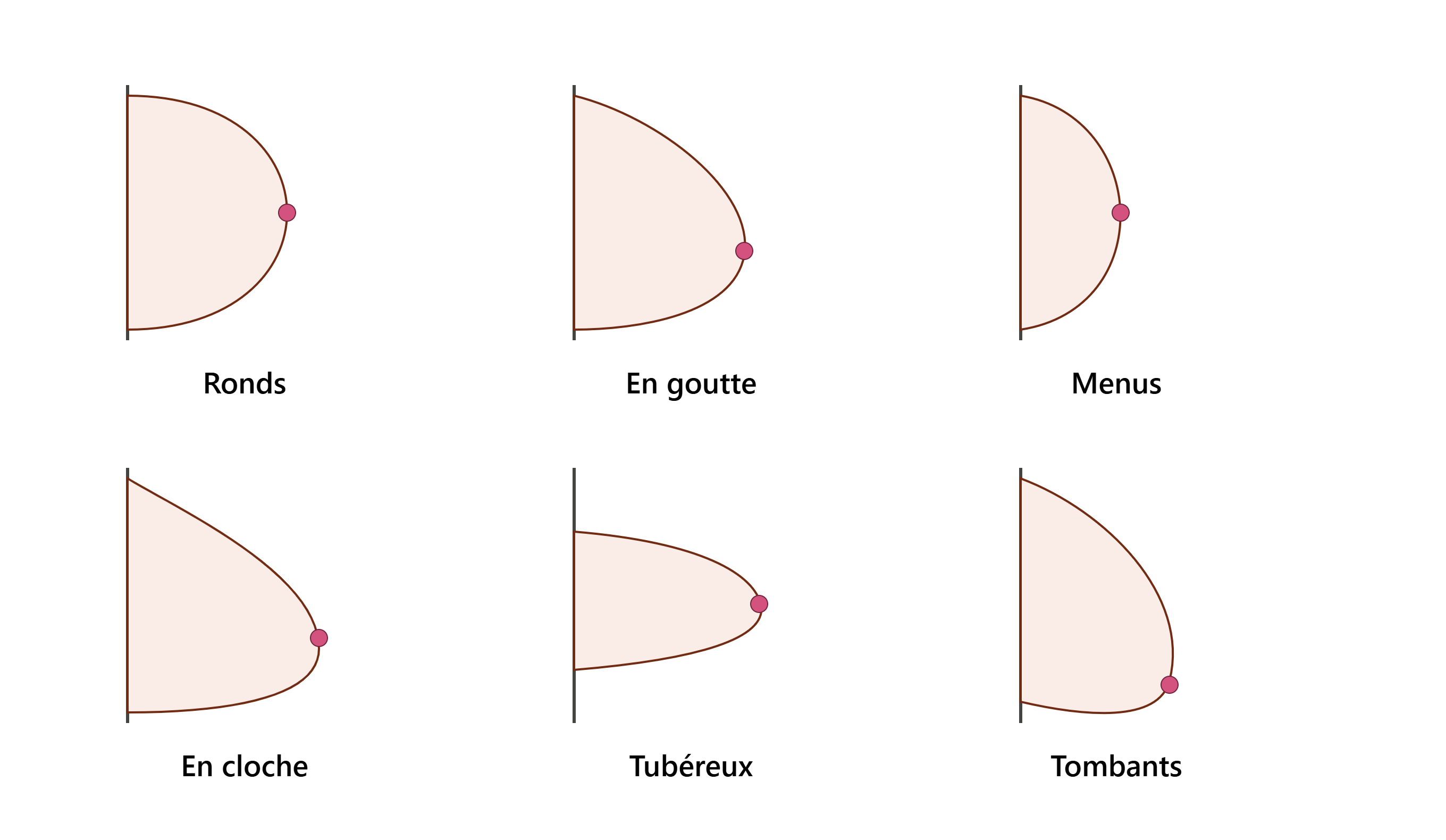
The female chest shows considerable anatomical diversity. There are round breasts, more elongated breasts, pear-shaped breasts, conical or triangular breasts, and breasts whose placement creates a larger or smaller gap between the two sides. The shape of the breasts can also change over the course of a lifetime.
Get a price estimate for your surgery!Fill out the form below quickly.
|
So there is no single normal breast shape. Size, contour, nipple position, areola size and the distribution of tissue naturally vary from one woman to another. Even within the same pair of breasts, a slight difference can be perfectly normal.
Understanding the different breast shapes above all helps you get to know your own body better and tell a long-standing anatomical trait from a recent change that may deserve medical advice.
Why Are There Different Breast Shapes?
The shape of the breast depends on several factors. The breast is mainly made up of glandular tissue, fatty tissue and connective tissue. The proportion of these different tissues influences its volume, firmness and contour.
Genetics also plays a part in the shape of the chest. The width of the rib cage, the amount of fatty tissue, the elasticity of the skin and the development of the mammary glands all contribute to the chest shape we see.
Hormones also play a role. The breasts develop at puberty and can change in volume or consistency during the menstrual cycle. Pregnancy, breastfeeding, significant weight changes and menopause can then alter their appearance.
It is therefore quite possible that the breast shape seen at age 20 is no longer exactly the same several decades later.
The Main Breast Shapes
The terms used to describe breast types come mainly from morphological descriptions. They do not form a universal medical classification.
Round Breasts
Round breasts generally have a relatively even volume in their upper and lower portions. The contour of the breast can give a rounded appearance when the person is standing.
However, the term “round breast” is descriptive. It does not indicate whether the breast is more or less healthy.
Pear-Shaped Breasts
The pear-shaped breast generally has more volume in its lower portion. This shape can be perfectly natural.
Gravity, age and tissue elasticity can accentuate or reduce this appearance over time.
Apple-Shaped Breasts
The expression apple-shaped breast is used to describe a chest with more volume in the central portion. Again, this is a descriptive label and not a diagnosis.
Triangular Breasts
Triangular breasts can have a relatively wide base and a narrower projection toward the nipple. The term triangular breast is sometimes used in aesthetic descriptions of the chest.
Conical Breasts
The conical breast has a projection oriented more toward the front, with a shape that can resemble a cone. This characteristic can be present naturally, depending in particular on the development of the breast tissue and the shape of the rib cage.
Flat Breasts
Flat breasts have less projection. This expression does not mean that breast tissue is absent. A small-volume chest can have perfectly normal anatomy.
It is therefore best to avoid automatically associating “flat breasts” or a “flat breast” with an abnormality.
|
Descriptive shape |
General characteristic |
Is it a disease? |
|
Round breasts |
Relatively evenly distributed volume |
No |
|
Pear-shaped breast |
More volume in the lower portion |
No |
|
Apple-shaped breast |
More volume centrally |
No |
|
Triangular breasts |
Relatively wide base and narrower projection |
No |
|
Conical breast |
Forward-oriented projection |
No |
|
Flat breasts |
Low apparent projection |
No |
|
Wide-set breasts |
Larger gap between the two breasts |
No |
Wide-Set or Close-Set Breasts: Is It Normal?
The distance between the breasts varies considerably. Some women have wide-set breasts, with a visible gap at the level of the intermammary cleft, while in others the two breasts are closer together.
The intermammary cleft is the space between the two breasts. Its width depends in particular on how the breasts sit on the chest and on the shape of the sternum.
There is no ideal distance between the breasts. A naturally wide-set chest is therefore not necessarily less normal than a close-set one.
Wearing a bra can also temporarily change the appearance of the chest, but it does not permanently change the anatomical placement of the breasts.
Why Can One Breast Be Larger Than the Other?
A pair of breasts is not necessarily perfectly symmetrical. It is common for one breast to be slightly larger, lower or to have a different contour from the other.
You may therefore notice a larger left breast, a slightly different right breast or a difference in nipple position.
This asymmetry can appear as early as pubertal development. It can also change with hormonal shifts, pregnancy, breastfeeding or weight changes.
|
Situation |
Possible interpretation |
When to seek medical advice? |
|
Slight, long-standing asymmetry |
Common anatomical variation |
Not necessarily |
|
One breast slightly larger since puberty |
Asymmetrical development |
Worth discussing if it is significant or bothersome |
|
Recently appeared difference |
Several possible causes |
Consultation recommended |
|
Breast suddenly become harder |
Change to be identified |
Medical consultation |
|
Change in shape accompanied by a lump |
Abnormality requiring an examination |
Prompt consultation |
|
Recent nipple retraction |
Cause to be investigated |
Medical advice recommended |
A long-standing, stable difference does not have the same significance as a recent change.
The Different Nipple Shapes
The shape of the nipples also varies from person to person. In medical vocabulary, the term “nipple” is generally preferred over more informal words.
You may notice protruding, flat or inverted nipples. Their size, orientation and that of the areola can also differ between the two breasts.
Normal nipples therefore do not have a single appearance.
A normal nipple can project more or less. Some women naturally have a flat nipple, while others have inverted nipples or retracted ones.
When a nipple has always been inverted, this may simply be an anatomical trait. However, a retraction that appears recently deserves a medical evaluation.
Areola and Nipple
The areola and nipple form a particularly variable area. The color, diameter and texture of the areola can differ from one person to another.
The size of the areola can also change over the course of a lifetime, particularly during pregnancy. An areola that changes shape recently or together with other changes should be shown to a healthcare professional.
What Is the Makeup of the Breast in a Woman Who Is Not Pregnant?
To understand the different breast shapes, it helps to know what they are made of.
The breast mainly contains glandular tissue, fatty tissue and connective tissue. The glandular tissue includes the lobules and ducts. The nipple sits at the center of the areola and is the end of the milk ducts.
The amount of each tissue varies with age, hormones, genetics and other factors.
A diagram of the breast generally shows:
- the skin;
- the fatty tissue;
- the glandular tissue;
- the lobules;
- the ducts;
- the nipple;
- the areola;
- the supporting structures.
The composition of the breasts partly explains why their consistency is not the same in all women.
Breast Size and Chest Shape
Breast size and shape are two different characteristics. Two women wearing a similar bra size can have very different shapes.
Size can be described using different measurements or cup sizes, but these are not enough to define the chest shape.
An A, B or C cup breast can be round, more elongated, wide-set or have another shape. Breast volume is therefore not the same as shape.
The weight of a breast also varies with its volume and composition. There is no universal weight that defines a “normal” breast.
What Does “Natural Breasts” Mean?
The expressions natural breasts, natural breast or natural chest generally refer to a chest that has not been surgically altered by an implant or cosmetic reconstruction.
But a natural chest can have a very wide variety of shapes: round breasts, flat breasts, wide-set breasts, asymmetrical breasts or conical breasts.
It is therefore better not to associate “natural” with any particular appearance.
Likewise, having one breast larger than the other does not necessarily mean there is an abnormality.
Changes That Call for a Consultation
The usual shape of the breasts matters less, medically, than the appearance of a new change.
It is advisable to see a doctor when a person notices, in particular:
- a new lump in the breast;
- unusual thickening;
- a recent change in shape;
- new nipple retraction;
- a persistent skin change;
- unusual nipple discharge;
- a recent change in the areola;
- persistent or unusual pain;
- a difference in volume that appeared suddenly.
These signs do not automatically mean cancer is present. Many breast changes have benign causes. However, their origin cannot always be determined simply by looking at the shape of the breast.
“Ugly” or “Weird” Breasts: Mostly an Aesthetic Notion
Internet searches containing the phrases “ugly breasts”, “weird breasts” or “different breasts” often reflect a concern about body appearance.
From a medical standpoint, these expressions do not correspond to any anatomical category.
A woman may have a particular breast shape, an asymmetry, flat nipples or a relatively large areola without any of this being a disease.
Images found online or aesthetic standards should therefore not be used to decide whether your breasts are “normal.”
Breast surgery may be considered in certain situations, whether cosmetic, reconstructive or intended to correct a functional problem. It should, however, be the subject of a personalized medical discussion.
A Normal Diversity Worth Knowing
The different breast shapes are numerous, and no popular classification can cover every shape.
Round breasts, pear-shaped breasts, apple-shaped breasts, triangular breasts, conical breasts, flat breasts or wide-set breasts: these descriptions let us talk about shape, but they are not diagnoses.
In the same way, the different types of nipples — protruding, flat or inverted — can be perfectly natural.
The most important thing is therefore to know your own chest. A new, persistent or unusual change deserves more attention than comparison with a supposed ideal shape.
Practical Tips
To keep a better eye on your breasts:
- Get to know their usual appearance.
- Regularly check their shape, skin and nipples.
- Do not worry about a slight, long-standing, stable asymmetry.
- See a doctor if a new change appears.
- Follow the screening recommendations suited to your age and risk factors.
- If in doubt, seek medical advice rather than trying to make a diagnosis yourself.
The diversity of breast shapes is an anatomical reality. There is no single perfect chest, and no single normal breast shape. What matters medically is above all recognizing changes that do not match your usual appearance.
FAQ – Different Breast Shapes
Is there an ideal breast shape?
No. There are many naturally normal breast shapes. The terms “round,” “pear,” “apple” or “triangular” are primarily descriptive.
Is it normal to have round breasts?
Yes. Round breasts are simply one possible shape among many others.
Is it normal to have one breast larger than the other?
A slight asymmetry between the two breasts is common. A new or rapidly appearing difference should, however, be evaluated.
Are flat or inverted nipples normal?
They can be a natural anatomical variation when they have been present for a long time. A recent inversion, on the other hand, should be checked by a doctor.
How can I tell if the shape of my breast is normal?
There is no single normal shape. The best reference point is your own usual appearance. A new change in shape, volume, nipple or skin should be examined.