
Testicular Biopsy: Procedure, Timelines, and Precautions
07 Nov
Testicular Biopsy: Procedure, Timelines, and Precautions
A testicular biopsy is a medical test that involves taking a small fragment of tissue or sperm directly from the testicles. It is often recommended as part of a male infertility workup or in vitro fertilization (IVF) with ICSI, when the semen contains no sperm.
This article answers the most common questions about the procedure, the timing, the requirements, and the precautions before and after the operation.
How Is a Testicular Biopsy Performed?
A testicular biopsy is a simple procedure and is generally well tolerated. It is performed:
- Under local or light anesthesia (sometimes general, depending on the case),
- On an outpatient basis (the patient goes home the same day),
- In a sterile operating room.
Procedure:
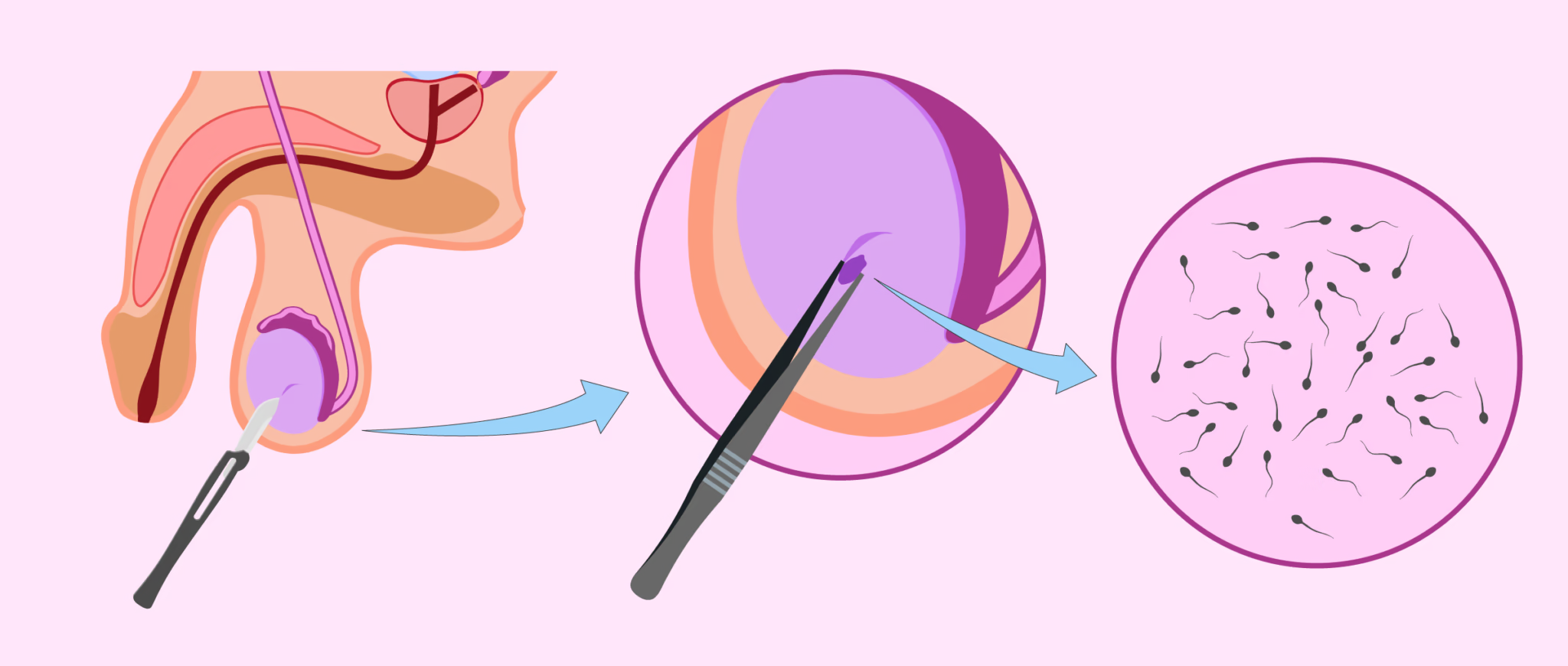
- The surgeon makes a small incision in the skin of the scrotum.
- They remove a fragment of testicular tissue containing sperm.
- The sample is then analyzed or frozen for a future IVF cycle.
The procedure lasts about 20 to 30 minutes. Some discomfort or a small bruise may appear, but they disappear within a few days. 💡 Avoid any intense physical activity or sexual intercourse for 5 to 7 days after the biopsy.
Get a price estimate for your surgery!
Fill out the form below quickly.
How Many Testicular Biopsies Can Be Done?
The number of biopsies depends on several factors: the condition of the testicles, surgical history, and the result of the first sample.
In general, a single biopsy is enough to obtain usable material. If needed, a second biopsy may be considered, often on the other testicle. Multiple biopsies must, however, be spaced out over time to avoid fibrosis.
👉 In practice, doctors recommend 1 to 2 biopsies at most, except in special cases.
How Many Days of Abstinence Before a Testicular Biopsy?
It is advisable to observe a period of abstinence of 2 to 5 days before the biopsy. This helps obtain a sample richer in sperm.
💡 Abstinence that is too long (more than 7 days) can, on the contrary, reduce the quality of the sample. The ideal is therefore to wait 3 days before the biopsy.
How Long Before Having a Testicular Biopsy?
The biopsy is offered after a complete fertility workup reveals azoospermia (absence of sperm in the ejaculate).
The preliminary steps include:
- Two semen analyses spaced several weeks apart,
- A hormone panel (FSH, LH, testosterone, inhibin B),
- A testicular ultrasound.
After these tests, the biopsy can be scheduled within the following weeks, depending on the fertility center’s schedule. If IVF is planned, the date is coordinated with the partner’s cycle.
How Many Months Between a Sample and a New Testicular Biopsy?
If the first biopsy did not yield any sperm, a new attempt may be considered after a minimum of 3 to 6 months.
This interval allows for the regeneration of germ cells and the complete healing of the testicular tissue.
The doctor assesses the situation according to the type of azoospermia, previous results, and the conception strategy (IVF-ICSI, TESE, micro-TESE).
💡 Between two biopsies, a treatment to stimulate spermatogenesis (vitamins, antioxidants, hormones) may be offered.
Can You Have a Testicular Biopsy If You Are HIV-Positive?
Yes, a testicular biopsy is possible in an HIV-positive patient, under strict medical supervision. Assisted reproduction and infectious disease teams work together to ensure maximum safety.
The sperm collected is then washed and processed to eliminate any trace of the virus, and then used in IVF-ICSI.
💡 These procedures are performed only in HIV-approved centers or secure assisted reproduction centers.
When Can a Second Testicular Biopsy Be Done?
A second biopsy may be considered after 3 to 6 months, depending on the results of the first sample. If sperm has been frozen, a new biopsy is not necessary.
If the first sample is negative, a micro-TESE (microscope-assisted biopsy) may be offered to increase the chances of success.
💡 The decision to repeat a biopsy depends on the medical evaluation and the couple’s fertility plans.
A Key Step in the Male Fertility Workup
A testicular biopsy is a safe and effective test for diagnosing male infertility or collecting sperm for IVF. Performed in a specialized center, it now offers excellent success rates thanks to modern techniques.
👉 Consult a specialized andrologist or urologist for personalized, reassuring care.