
Healthcare in Tunisia: First Ultrathin Corneal Transplant
21 Apr
Healthcare in Tunisia: First Ultrathin Corneal Transplant
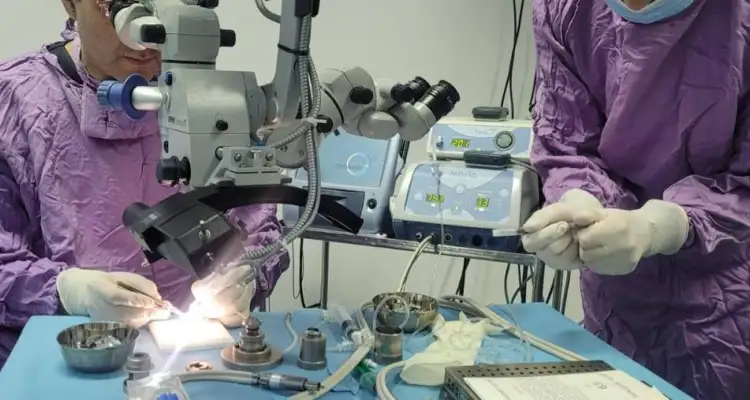
April 19, 2025 marks an important date in the history of Tunisian medicine. The Ministry of Health announced, via its Facebook page, the first ultrathin corneal transplant performed at Charles Nicolle Hospital in Tunis. A highly precise surgical procedure, carried out by an entirely Tunisian team, it opens the way to new hope for patients suffering from serious eye conditions.
Get a price estimate for your surgery!
Fill out the form below quickly.
A Major Technological Advance
The transplant was made possible by cutting-edge technology: ultrathin corneal replication. Using high-precision instruments such as the microkeratome, this technique makes it possible to cut and graft an exceptionally thin layer of cornea, thereby reducing the risk of rejection and speeding up post-operative recovery.
This success is more than a technical feat. It marks a turning point for the country's health sovereignty, reducing dependence on imported corneas and considerably shortening waiting times for patients.
Public Hospitals Under Strain
But behind this success lies a more contrasting reality. The Tunisian public health system continues to face many structural challenges. Despite advances in medicine and the skill of medical staff, working conditions in hospitals remain precarious. Some patients are still forced to buy basic supplies themselves, such as syringes, dressings, and even medication, because public facilities lack sufficient resources.
This situation regularly fuels criticism of a two-tier system, where innovation coexists with improvisation and where inequalities in access to care persist from one region to another.
Initiatives to Turn the Tide
Aware of these shortcomings, the Ministry of Health is stepping up initiatives to modernize infrastructure and improve the quality of care. Following the announcement of the installation of modern medical equipment in Nabeul, similar projects are under way in Gabès and Kébili, as part of a broader effort to decentralize specialized care.
The “Santé Aziza” program, launched to strengthen the capacity of regional hospitals, has already led to significant progress. In Kébili, ophthalmology and cardiology clinics have been opened in the medical centers of Blidat, El Faouar, and Souk de Douz. Cutting-edge equipment such as surgical saws, Doppler echo machines, cardiac Holter monitors, and audiometry devices has been deployed.
Notable measures include:
- The activation of operating rooms and nutrition clinics at the regional hospital, with the support of eight specialist physicians.
- The installation of a biological analyzer in Blidat, and the connection of the Souk de Douz health center to the SantLab information system.
- Plans to expand the Douz hospital.
- The equipping of the nursing school with modern simulators for advanced training.
- Stronger support for monitoring sugar stocks in several regions of the South.
Between Promise and Reality
The first ultrathin corneal transplant in Tunisia is undeniably a major medical and technological success. But it also highlights the contrast between the excellence of certain teams and the systemic shortcomings of the hospital network. Tunisia is moving forward, certainly, but at an uneven pace.
The challenge now is to ensure that these technological breakthroughs benefit all Tunisians, regardless of their region or circumstances. Health cannot be a privilege; it must remain a right. And for that right to be fully effective, innovation must be accompanied by a constant effort of reform and territorial rebalancing. It is at this price that Tunisia will truly be able to achieve its medical revolution.
A brief statement describing the purpose and mission of the clinic. This may include a commitment to patient care and community health.

Welcoming our new patients
We are welcoming
new patients